Spin and Go Strategy 2026: Preflop Charts & Exploits
 Updated: 16 Oct 2026
- Beating Spin & Go tournaments (a.k.a. Spins) requires two separate strategies: one for recreational players, one for regulars.
- GTO Wizard is a useful tool, but solver snapshots alone won’t win you money. You need practical, playable simplifications.
- Preflop is where many costly mistakes happen and where many of the big exploits live. Leave basic push fold charts behind.
- This guide covers everything from how to exploit recreational players to preflop ranges, postflop board texture, and how to improve faster with coaching.
You’ve been playing Spin & Go poker games for a while. You’ve looked up some push fold charts. Maybe you’ve even opened GTO Wizard and stared at a range snapshot. But you’re still not moving up, and you’re not sure why.
The problem isn’t that you lack information. It’s that most Spin & Go strategy content stops at the solver output and calls it a day. It doesn’t tell you when to follow the chart, when to throw it out, or how to adjust based on who’s actually sitting across from you.
This guide breaks down that entire thought process: from how to approach recreational players at lower stakes, to the simplifications that make mid-stakes strategy actually playable, to the nuance required at the top of the ladder.
New to the format? Check out our complete Spin & Go poker guide for format basics, payout structures, and site comparisons, or start with our beginner guide.
HOW TO USE THIS GUIDE
The way you should approach Spin & Go strategy depends heavily on where you are in your journey.
At lower stakes, the priority is your game against recreational players. Solver charts from GTOWizard are a useful starting point, but they’re not enough on their own. You need to think beyond them and actively spot when you can, and should, deviate based on what your opponent is likely to do wrong.
At mid-stakes, the focus shifts to simplifications against other regulars. Pure GTO may look impressive on paper, but it’s barely playable in practice, especially when you’re multi-tabling. Clean, actionable Spin & Go strategy tips that are easy to execute matter far more.
At high stakes, complexity and nuance become the priority. This is where nodelocks, dynamic equilibriums, and opponent-specific adjustments come into play.
Here’s the roadmap in short:
- Start with your game against recreational players; focus on regulars later
- Aim for simplicity in the beginning
- Don’t stop at GTO snapshots, think about what actually happens in practice
- Most competent regs develop two separate strategies depending on who they’re facing
WHY GTO WIZARD ALONE WON’T WIN YOU MONEY
GTO Wizard is excellent for off-table study. But there’s a gap between understanding a solver output and beating actual opponents at Spin & Gos, and it’s wider than most players expect.
Three reasons:
- Solver solutions assume a perfect opponent. Your actual opponents aren’t playing perfectly. A balanced strategy often leaves significant value on the table against someone who folds too much or calls down too wide.
- Range snapshots aren’t executable at speed. Applying a GTO Wizard solution correctly across multiple tables under pressure is a different skill from using the range in-game.
- Spin & Go has format-specific dynamics solvers underweight. Hyper turbo blind structures, prize pool distribution, and short starting stacks all require practical adjustment that a solver doesn’t necessarily provide.
The right approach is to use GTO Wizard as a reference and study tool, then build simplified, executable strategies on top of it. That translation layer is what a coaching program gives you that a solver subscription alone doesn’t.
Studying solver output tells you what you should be doing, but it doesn’t tell you what you’re actually doing at the tables. That gap is where most leaks live, and it’s invisible until someone (or something) points a hand history back at you.
At bitB Spins, we have built our very own Leakfinder tool that closes this loop: it scans your own hand histories and flags exactly where your in-game play drifts from our reference strategy, so you’re fixing real leaks instead of guessing at them.
GTO VS. EXPLOITATIVE PLAY
In Spin & Go, the right strategy isn’t the same against every opponent.
Against recreational players, you can afford to be blatantly exploitative: widening ranges, sizing for maximum mistakes, and ignoring balance entirely.
Against regulars, you need a tighter, more disciplined approach.
Understanding the difference between these two modes, and when to switch, is one of the most important skills you can develop.
PLAYING AGAINST RECREATIONAL PLAYERS
HOW RECREATIONAL PLAYERS THINK AND BEHAVE
A quick but important note: when professionals talk about strategy against recreational players, there’s nothing condescending about it.
We all started somewhere. We’ve all gone through learning curves, rough patches, and growth. There’s nothing wrong with being new to the game.
That said, recreational players do have consistent tendencies worth accounting for:
- They tend to be more transparent about hand strength. Passive usually means weak, and aggression usually means strong.
- They adjust more slowly, and less optimally, to what you’re doing,
- You can tailor your strategy to the specific spot without worrying as much about how it looks across your whole range.
In short: against recreational players, situations frequently matter more than your exact cards.
HOW TO EXPLOIT RECREATIONAL PLAYERS IN PRACTICE
Here’s a simple example. A recreational player minraises preflop, then bets the flop, turn, and river with a large sizing. Should you bluff-catch as wide as GTO suggests? Almost certainly not.
Another one: the same player seems completely disinterested, checking down every street. You have a weak hand that a solver would bluff two-thirds of the time. Should you stick to that frequency, or always bluff? Always bluff.
These examples seem basic, but they reveal an important truth: beating recreational players doesn’t require fancy tricks. You don’t need to win massive pots or make hero calls. Pick your spots, fight for uncontested pots, and you’ll do just fine.
A few useful heuristics to guide your decisions:
- Draw-heavy boards are easier to defend. There are plenty of obvious combos (pairs, draws, made hands), so you should not be overly aggressive, as recreational players will be less likely to make a mistake.
- Dry textures are trickier, harder to defend. Your c-bet range should be wider to benefit from your opponents’ mistakes.
And always be intentional with your bet sizing. Ask yourself:
- If you’re betting for value, which hands do you want called? How much will they pay?
- If you’re bluffing, which hands are you trying to fold out? What size achieves that?
- Will your opponent make a bigger mistake facing a large bet or a small one? Is their calling range elastic or static?
Think through this before you bet. If you were bluffing and got called by a hand better than your target (say, you were targeting middle pair and got called by top pair), that’s fine.
But if the specific hand that you wanted to fold out called your bluff, there’s a problem: wrong spot, wrong player profile, or wrong size. Experiment, but stay intentional.
Want to see these exploits applied in real time? bitB Spins’ Spin Academy includes liveplay footage and hand reviews focused specifically on recreational player exploitation at every stake level. Try it free for 30 days here!
PLAYING AGAINST REGULAR PLAYERS
WHAT TO EXPECT FROM REGULAR PLAYERS
How you approach regulars depends heavily on the stakes. At lower levels, regs share many of the same weaknesses as recreational players — they’re still learning. At higher levels, you can expect solid preflop and postflop fundamentals.
The lower the stakes, the more openly you can exploit leaks. At higher stakes, you’ll need to identify which combos have similar EV and use those hands for your exploitative moves.
Regardless of the stakes, keep these principles in mind:
- Don’t try to replicate what you see in GTOWizard. Aim for playable simplifications instead.
- Observe tendencies and think actively about what would happen if the villain shifted their strategy, intentionally or by accident.
- Don’t assume regs are solid. Test them first; your respect should be earned.
- If you see a surprising showdown, don’t automatically write it off as incompetence. It might be something worth learning from.
- Tag players and leave short notes where appropriate, and always stay within site rules to keep your account safe.
HOW TO EXPLOIT REGULAR PLAYERS IN PRACTICE
Your priorities will vary depending on your current stake level:
- $10s: You’re likely just beginning to build a separate strategy for regulars.
- $50s: You’re sharpening your adjustment toolkit based on opponent tendencies
- $250s: You’re either applying clean simplifications across all spots and focusing elsewhere (table count, villain-specific reads), or gradually improving precision across the game tree.
If you’re playing the $10s, here’s what to focus on first:
- Your default strategy is probably exploitative, but therefore it is also exploitable. What are other regs likely to target, intentionally or not?
- Where do you expect regs to play like they would against recreational players? Does that make them vulnerable? How can you take advantage?
One more important point: the mistakes you make are often the same ones your opponents make.
If you identify a leak in your own game, check whether you can also exploit it in others. And if you find a glaring weakness in their game, make sure you’re not exposed in the same way.
HOW TO PLAY PREFLOP IN SPIN & GO
Preflop decisions in Spin & Go are heavily influenced by two things: stack depth and who you’re playing against.
The same spot, same position, same stack size, calls for a completely different range depending on whether you’re facing a recreational player or a reg.
GTO equilibriums give you a useful baseline, but in practice, the best preflop strategy for either player type looks quite different from what the solver outputs.
SPIN & GO CHARTS AND RANGES IN MULTIWAY POTS
Let’s look at some practical examples using a 3-way SB vs. BB preflop spot at 15bb depth.
Here’s what a GTOWizard snapshot shows as the equilibrium starting point:

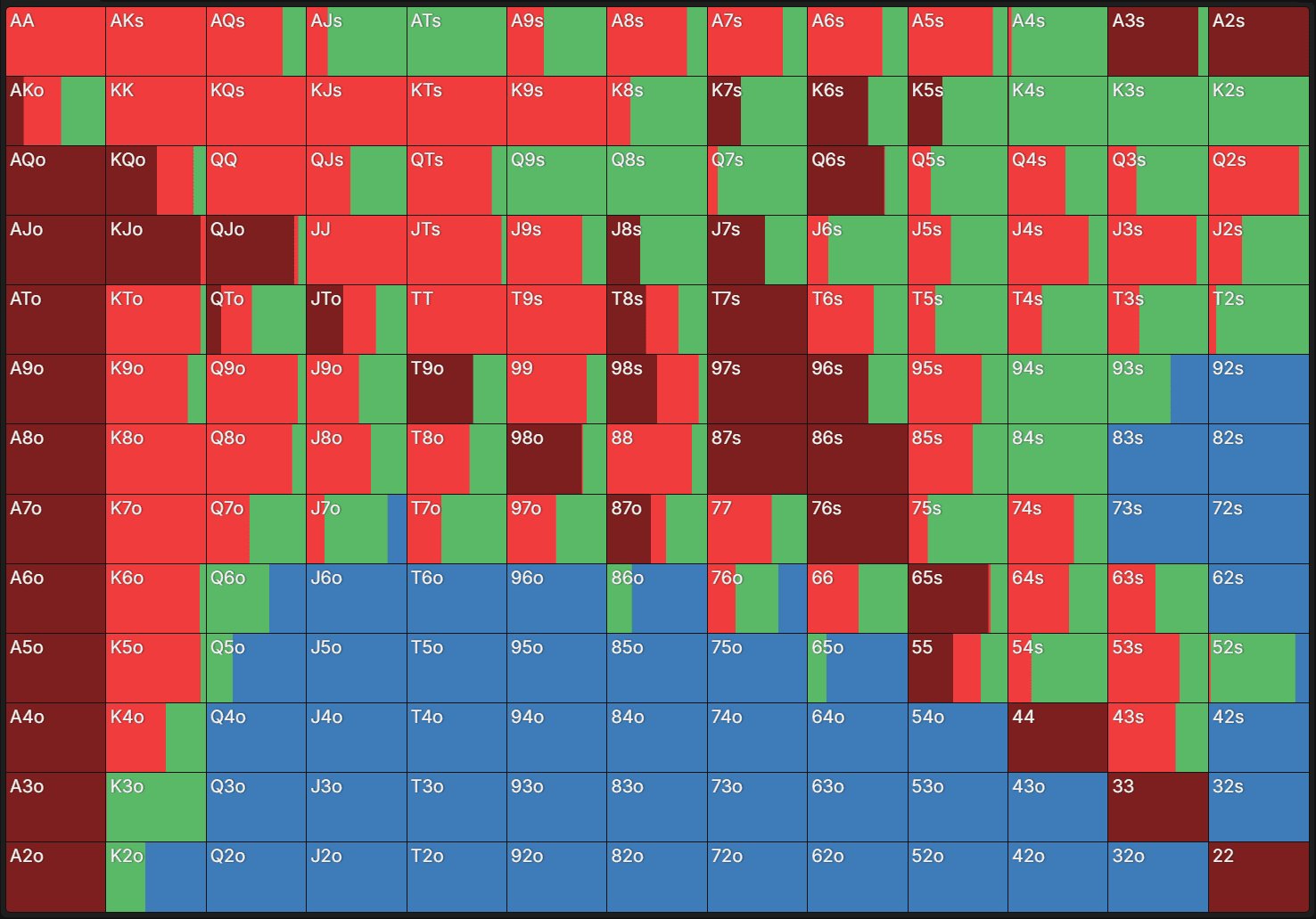
In practice, a range like this is not practical against recreational players or against regulars.
Against recreational players, a range like this works better:
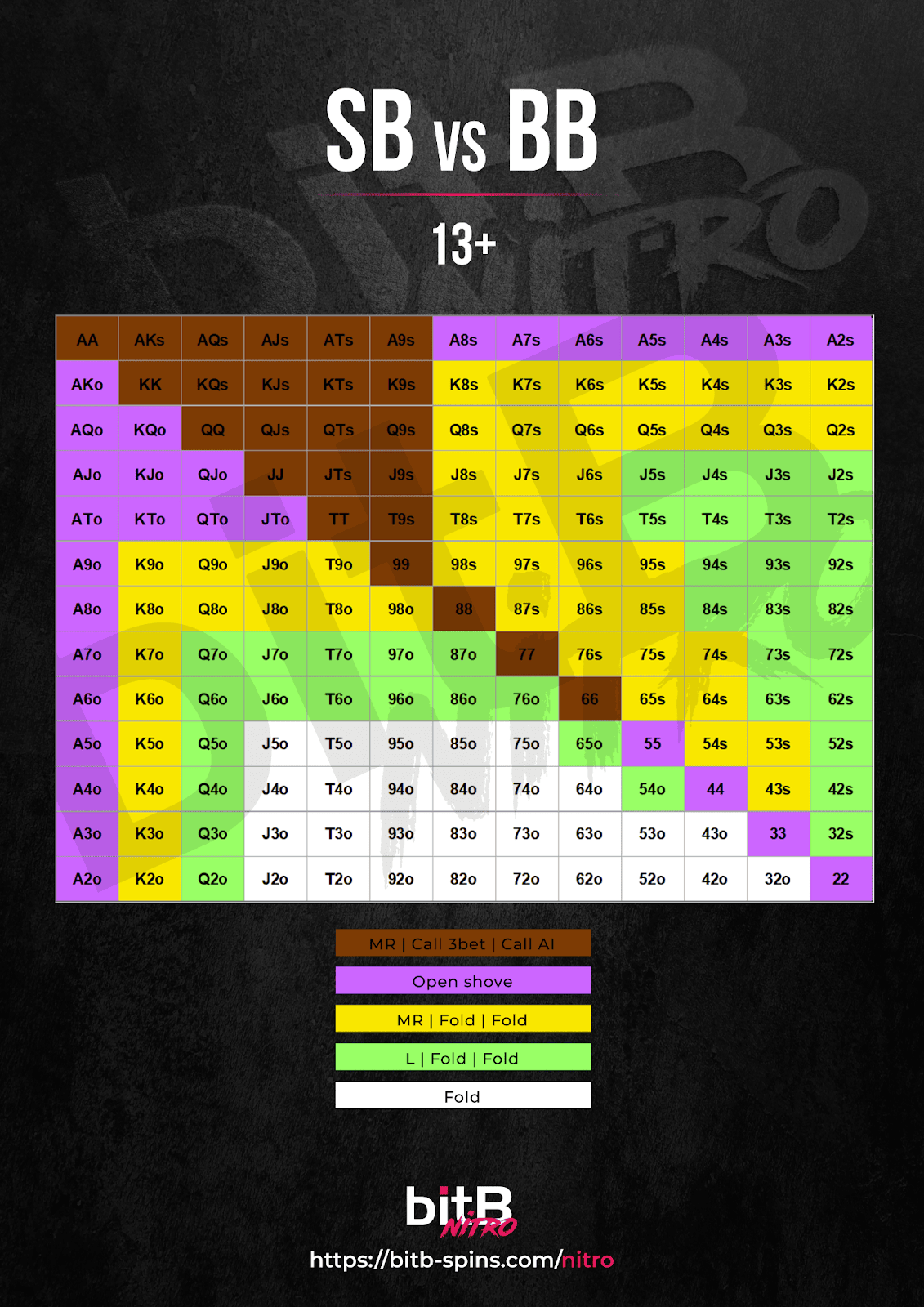
You’ll notice it’s wider and more straightforward: strong hands open-shove or min-raise, medium hands limp, and the weakest hands fold.
Yes, a perfect opponent could exploit this easily. The limp/fold frequency alone is an obvious target. But those vulnerabilities are intentional:
- We play wider, expecting recreational players to offer less resistance than the solver assumes.
- We build bigger pots with strong hands and keep pots small with weaker ones.
- We don’t expect recreational players to accurately read how we split our range preflop, so balance matters less here.
- We will not play enough hands versus any particular recreational player for them to even get a good idea of what our strategy is.
Against regular players, the approach flips entirely. Expect them to be aggressive with non-all-in iso-raises and all-in iso-raises as well. Playing wider against them out of position will likely backfire.
Instead, remove limping entirely and condense your range to 2.5x raise only (plus open-shoves), which lets you play fewer hands but with more aggression.
GTOWizard has some solutions with a similar logic, using 2x raises and without limps:

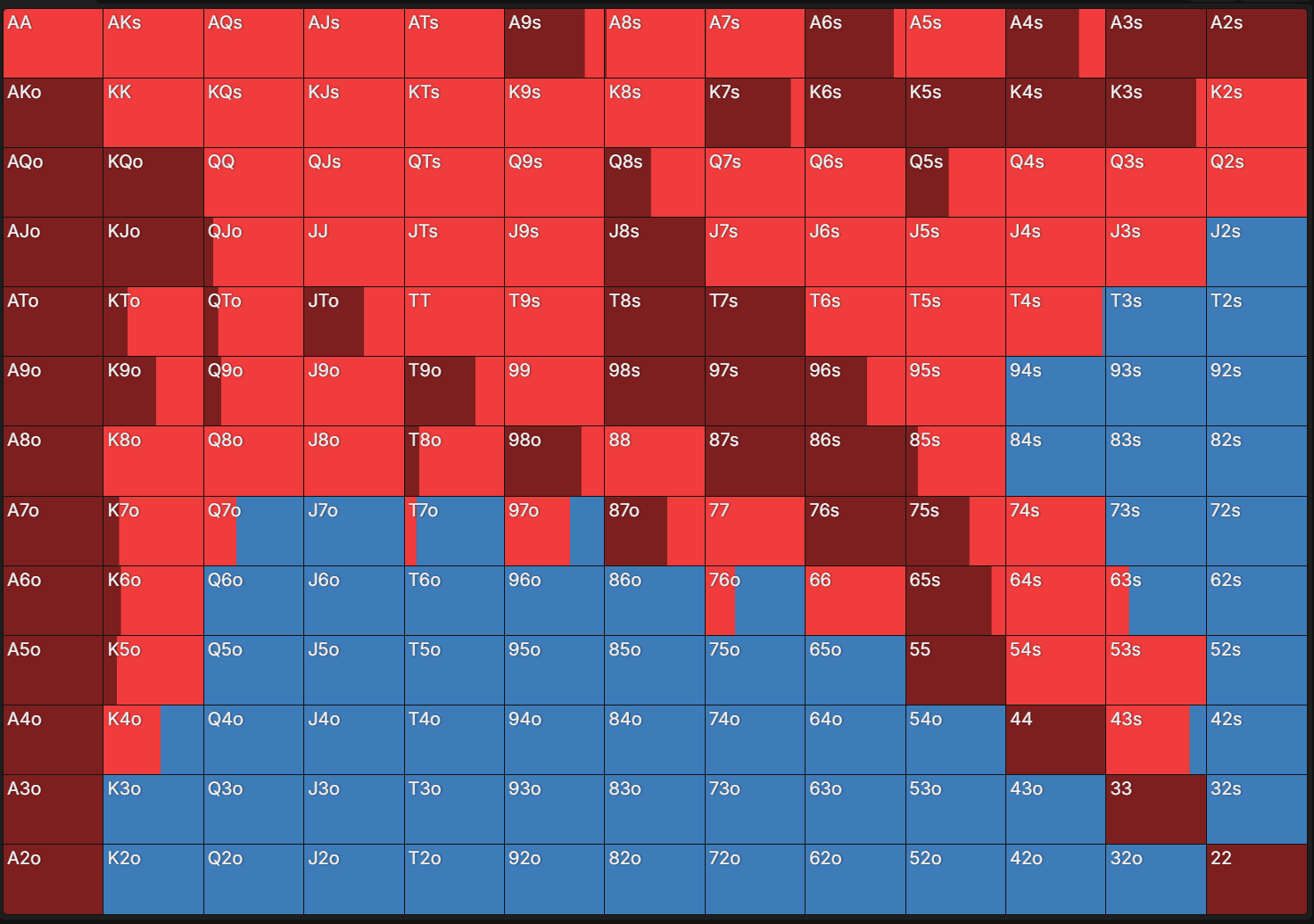
Our in-house version improves on this slightly. A 2.5x sizing plays better, and rounding to full combos makes it more practical at the table, especially when multi-tabling.
The best part? You don’t even sacrifice any real EV for these features.
The main lesson: a pure GTO equilibrium works for neither player type.
Practical ranges against recreational players and regulars should further be improved and simplified, but in very different directions.
PUSH/FOLD CHARTS AND SHORT STACK PLAY IN HEADS-UP POTS
Now let’s shift to shorter stack depths.
Many beginners assume that shallow stacks mean push-or-fold only. That’s a mistake.
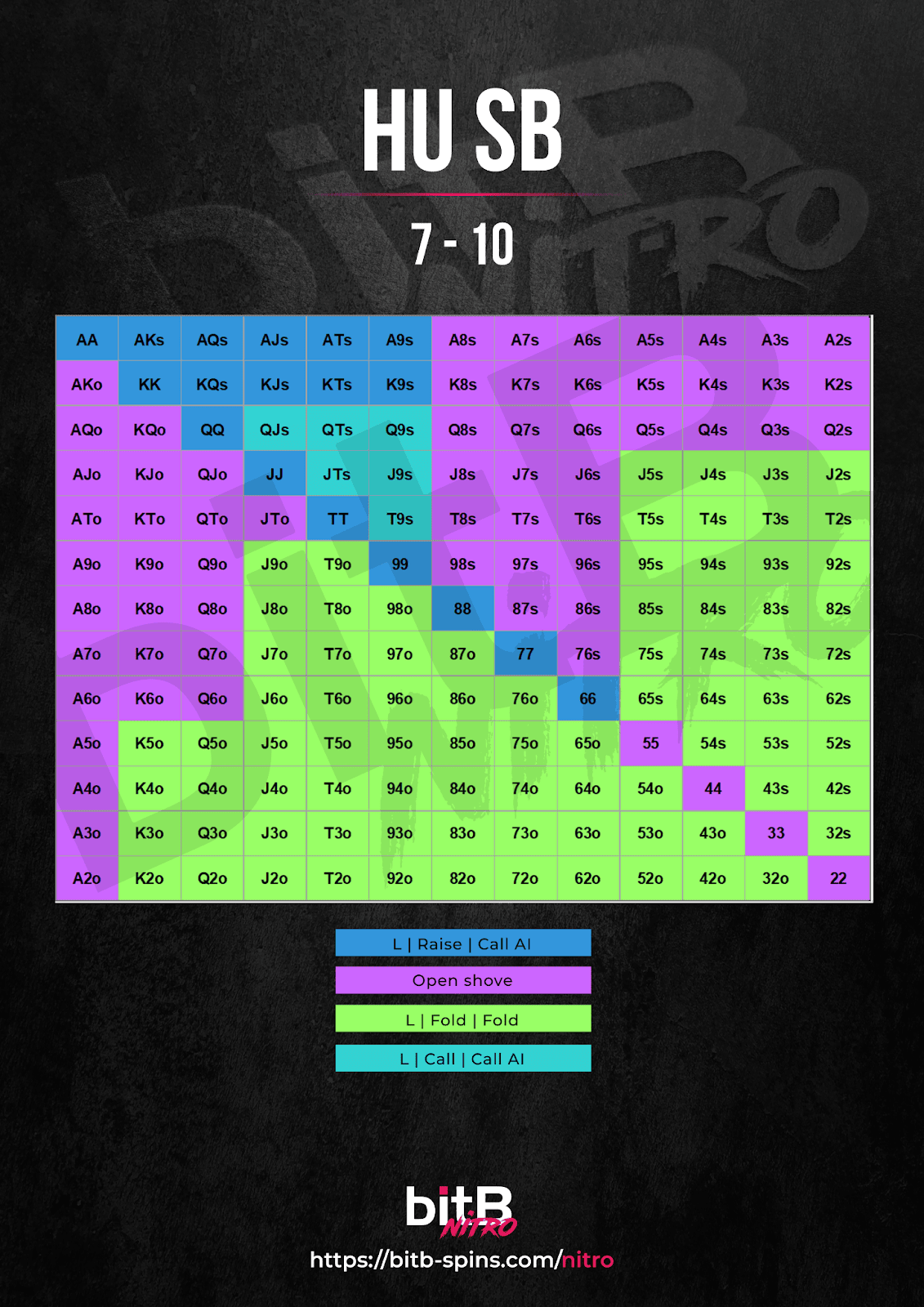
Even below 10 big blinds, the right approach against recreational players is to play as wide as you can get away with.
Sure, taking down a pot with 7-2 offsuit takes skill, whether that’s c-betting wide or picking between a bet-bet-bet and a bet-check-bet line after being called, but these are skills worth developing.
Against regular players, be much more careful. Notice how tight the GTO equilibrium is at 8.5bb:

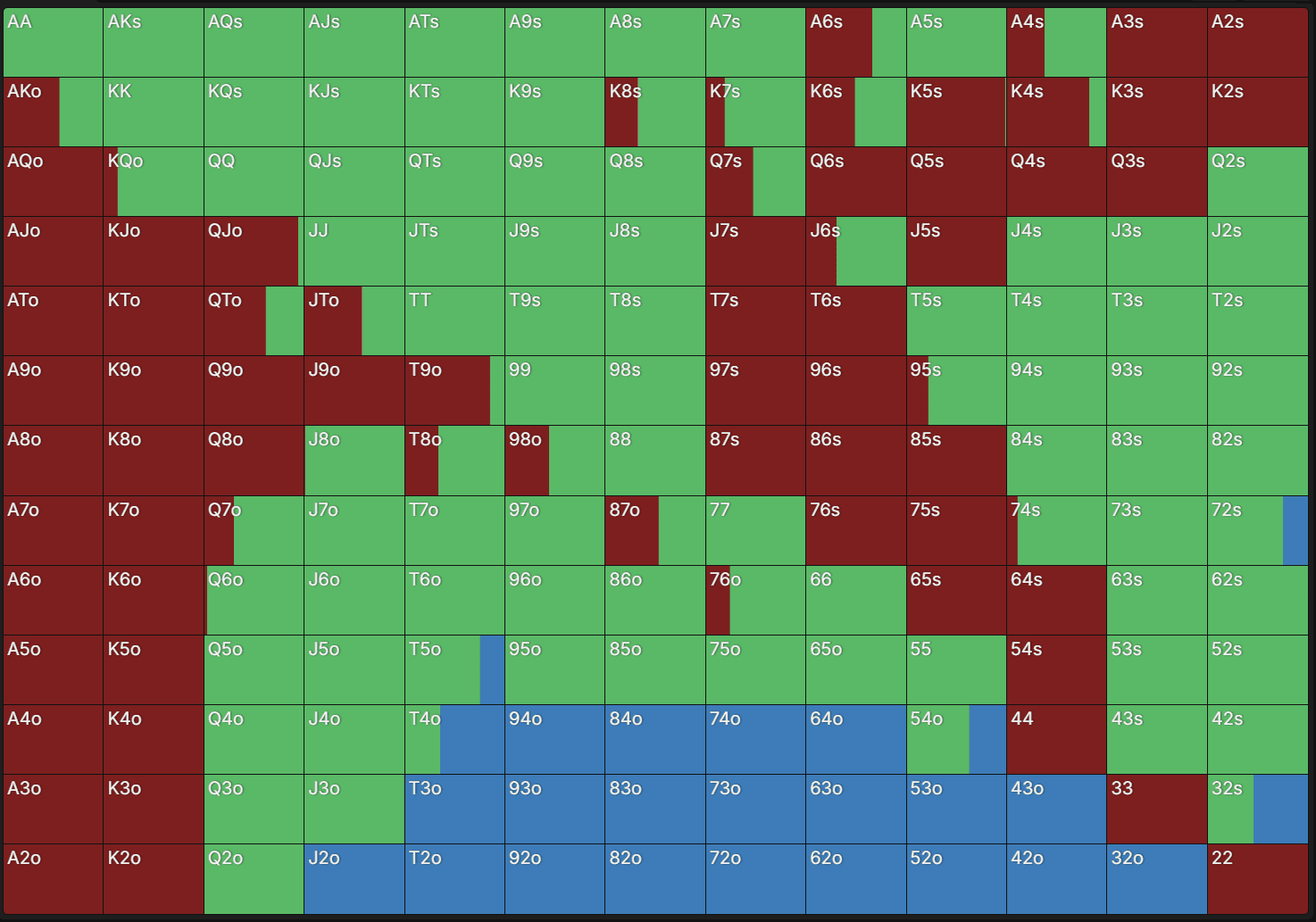
Forcing very high VPIP against regulars is a costly error. Not only does it leave you wide open to isolation bets from the big blind, it’s not even clear that the extra hands are profitable in the first place.
Want preflop charts built specifically for Spin & Gos? Spin Academy players receive stake-specific charts covering every preflop situation, including multiway pots, short stack heads-up play, and exploitative adjustments vs recreational players. Start your free 30-day trial here!
HOW TO PLAY POSTFLOP IN SPIN & GO
Just like preflop, postflop decisions don’t exist in a vacuum. The texture of the board, the pot you’re in, and who you’re playing against all shape how you should proceed.
The same flop that calls for aggression against a recreational player might demand caution against a reg who defends well and check-raises at high frequency.
HOW BOARD TEXTURE SHAPES YOUR RANGE IN MULTIWAY POTS
The same flop can play out in completely different ways depending on not just who you’re up against, but on what preflop range you’ve been using.
Let’s look at a 3-way SB vs. BB spot to see how this plays out in practice.
Take a 8-5-3 rainbow flop:
- Against a recreational player in a limped pot: Proceed with caution. The board connects reasonably well with their range, and blindly barrelling three streets is not always optimal here. Consider checking and looking to attack on the turn and river instead.
- Against a regular player in a 2.5x pot: The texture tells a different story. Three and five don’t connect well with either player’s range, and while eight does, SB still holds a relative range advantage. You have more room to apply pressure here.
One more key distinction: in a limped pot, you physically cannot bet less than 50% of the pot on the flop (that’s 1bb), but in a raised pot, you can size down.
As a general rule, you can trade a lower sizing for a higher betting frequency, which opens up more strategic options on the flop.
C-BETTING AND ADJUSTING IN HEADS-UP POTS
Once again, your approach to any flop depends entirely on who’s sitting across from you.
Consider a J-5-4 suited board:
- Against hobby players: You have a strong argument for betting a wide range. Heads-up big blind should be defending more than half their hands against a 1bb c-bet, including not just pairs and draws, but also high cards with backdoor equity. If you suspect a possible overfold, more of your hands start preferring a bet.
- Some hobby players weaken their range further by leading out, and others fastplay their strong hands on the flop, leaving them less defended on later streets. Both tendencies are worth exploiting.
- Against regular players: They are more likely to defend correctly and check-raise more aggressively. You need to be more selective with your c-betting strategy against regs, even on drier boards.
In fact, over-c-betting vs regulars in heads-up small blind in position is one of the most common leaks among lower-stakes players.
Make a clear distinction between how you c-bet against recreational players and how you c-bet against regs. It’s one of the higher-value adjustments you can make.
HOW TO TURN THIS STRATEGY INTO RESULTS FASTER
It’s absolutely possible to grind, study, and improve on your own. But progress is dramatically faster with structured guidance: someone to walk you through the concepts you haven’t encountered yet, point out the spots you’re misplaying, and give you targeted resources like video reviews and hand discussion threads.
If you want that guidance built around your stake and format, our Spin & Go coaching page explains how it works. Here’s what bitB Spins offers at every stage.
SPIN ACADEMY: STRUCTURED COACHING FOR SERIOUS GRINDERS
Most players don’t join a coaching team because they’ve hit a wall. They join because working through every spot alone is slow. When the key spots have already been studied, categorized, and distilled into practical takeaways, you compress months of learning into weeks.
The high variance nature of Spin & Gos makes this even more important. Without a structured feedback loop, it’s easy to misread a bad run as a strategy problem, or worse, to miss a real leak because you’re focused on results instead of decisions.
At bitB Spins, we’ve built our expertise around taking players from lower stakes all the way to the top of the ladder, and we understand the specific needs at every step of that journey. Our coach-to-player ratio is deliberately kept small so that every player gets hands-on, personalized support tailored to their actual priorities. See how our coaching works in more detail.
If you’re serious about improving your Spin & Go strategy, consider applying to the 30-day trial of Spin Academy. No fees, no commitment, and you keep everything you learn.
Apply for the Spin Academy 30-day free trial here!
BITB SPINS DOJO
Not ready for a full coaching program yet? The DoJo is bitB Spins’ free entry point for Spin & Go players on Winamax. It’s designed to give you a meaningful head start no matter where you’re starting from.
Joining is free and comes with preflop charts for all positions, preflop & postflop strategy videos, two hours of Spin & Go liveplay footage, and a dedicated bankroll management video.
New Winamax players who sign up through bitB Spins also receive a 250€ first deposit bonus, access to 10+ coaching videos, and monthly 500€ freerolls.
Already have a Winamax account? Link it to bitB Spins and you’ll still unlock full DoJo access and everything inside.